
Buying Property on Koh Samui
Buying property on Koh Samui: what happens when the pump stops?
The agent opens a cupboard beside the pool and points to a pump. The taps work, the water in the pool is clear and the driveway is dry. Now imagine arriving home after several days without a normal water supply. How much usable water is left? Can a delivery truck make the last turn? Does the pump work when the power is out? Three fairly ordinary failures tell you whether the house will still function on a bad day and whether the plot next door is really ready to build on.
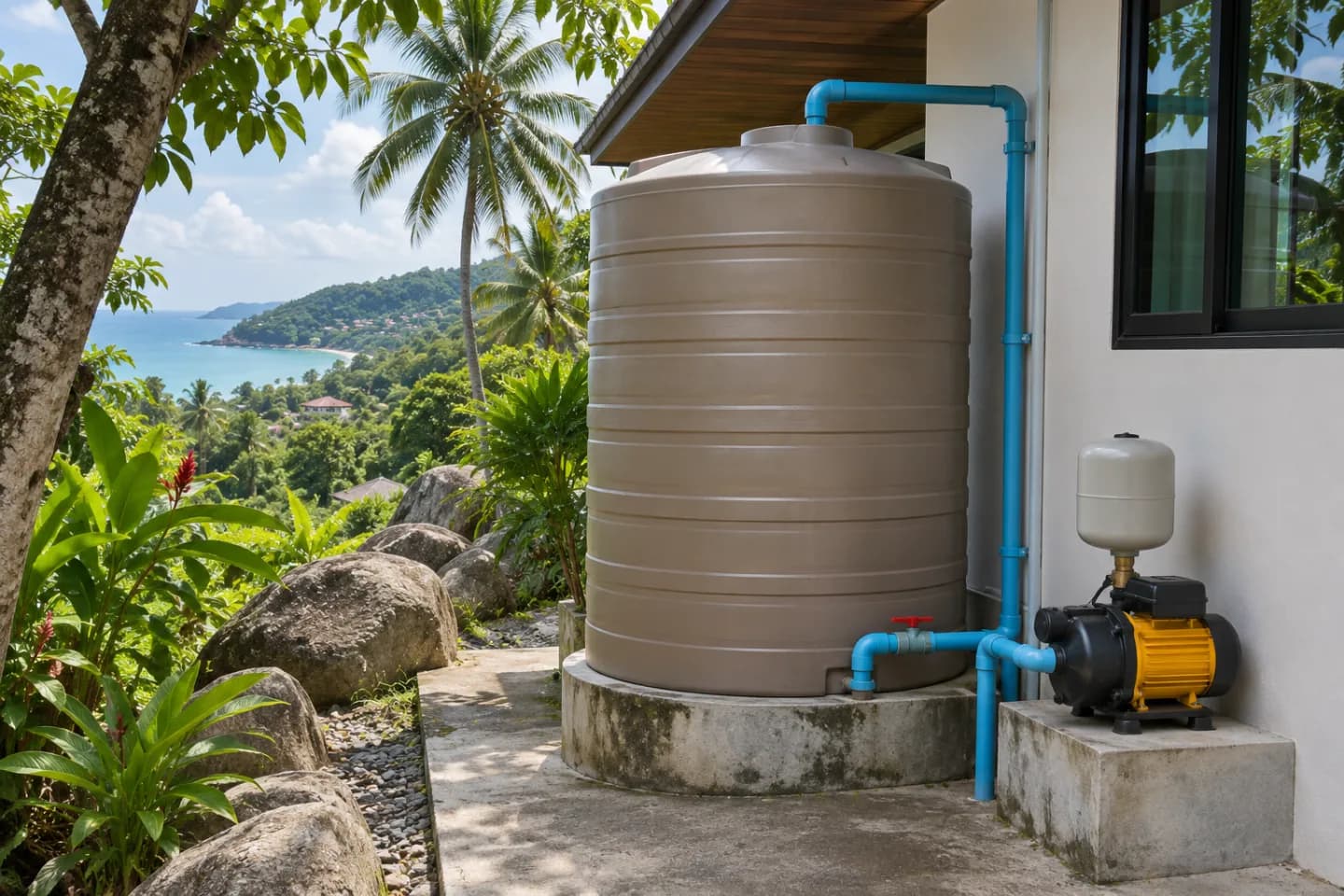
If the supply stops, find the first thing that runs out
The Provincial Waterworks Authority’s Samui drought response described reduced raw-water availability and disruptions especially at higher points and near the ends of distribution lines. That report is evidence that those conditions can matter. It does not identify the service history of a villa. Ask the seller for the bills and trace the actual system from its source through the meter, storage and pump. A house may rely on a shared estate network, a private source, delivered water or a combination. An owner who occasionally orders a tanker and one who does so throughout the dry spell have very different operating costs.
A tank’s model number can tell you nominal capacity. Ideally a technician should establish how much can be drawn under normal operation. If the system has 1,800 litres of usable domestic storage and the household uses an illustrative 450 litres a day, it has about four days at that consumption, assuming no refill and no other draw. Pool top-ups or garden irrigation can shorten that interval if they use the same supply. Find out which loads can be isolated and which equipment needs power. A written delivery quote is more useful once the operator has confirmed how close their vehicle can get and where the hose would run.
Where a well is part of the arrangement, obtain the records for the source and the terms on which it is used. Consider yield in the dry period, maintenance responsibility and testing for its intended use with a suitable laboratory. In a managed estate, there may be one account for the property and a separate agreement for water produced or delivered to the development. Match the meter at the house to the statement and see which costs are included.
If the road fails, who can put it back?
A drive uphill in an agent’s car proves the route worked on that trip. Look at the road from the inside bend as well as from the front seat. Water may run down the surface, cross it at a culvert or leave it at a point you cannot see from the villa. Return after rain when conditions are safe. Identify the short section that would prevent a delivery or access by emergency services if it failed.
One villa may use the road with five neighbours. Another may have rights over adjoining properties but depend on a retaining structure outside its title boundary. The title records can establish who has passage. The agreement and inspection are where you learn who can commission repairs, how costs are shared and how contractors reach the damaged section. The guide to checking access rights explains how to match the physical road to the parcels involved.
A vacant plot needs two access assessments. A household car is one. The contractor’s loads, turning space, temporary storage and delivery schedule are another. Have the builder walk the steepest stretch with the designer early enough to change the plan. If materials need to be moved into smaller loads, ask for the extra cost and time in writing.
Put your routine on the island, starting at the gate
In Bophut and nearby northeastern addresses, the airport operator identifies Samui Airport as being in Bophut. If proximity to the airport matters, drive to the actual drop-off from the property and check the return. Spend time in the bedroom during ordinary operations if aircraft noise might affect you.
Around Mae Nam, compare a property reached directly from a main route with one up a connecting lane. Test the ordinary journeys that justify the location. Ask who serves the specific water meter and address, and where a service truck would turn. Two homes with the same postal area may have very different approaches.
In Maret and around Lamai, compare the last leg between the main road and the property, especially on a slope. A walk to shops can look short on a map and include a road shoulder rather than a useful footway. In Taling Ngam or Lipa Noi, do the regular cross-island journey before building a purchase around occasional trips. Identify the groceries, repairs and appointments you would make in a normal month and put their actual destinations into the comparison.
If the house is still a drawing, check which design you can price
The environmental protection designation and maps for Samui are a starting point for site-specific enquiries. Take the coordinates, deed and survey to the responsible authority with a clearly labelled concept showing use, proposed size, height, building position and access. Ask which versions of the planning and environmental instruments apply. A visible house on the next parcel may sit in a different mapped area or have a different approval history. Have the adviser explain any overlays or boundaries that affect your own design. The buildability guide explains what the map, written planning response and building permit each cover.
For a completed villa, compare the approved plans, where available, with the pool, roofed parking, retaining walls and any rooms added later. An engineer should assess visible retaining structures and drainage where their condition could change the offer. The inspection also needs to record whose land the structures sit on and where repairs could be carried out. An attractive terrace has very little spare value if access to its supporting wall is unresolved.
Put ownership and occupation on a separate page. A villa sale can involve distinct arrangements for the land, building and shared infrastructure. Have independent Thai counsel confirm what can actually be transferred or registered, by whom and for how long. If the deal includes a lease, price it based on the enforceable term and the costs and consents attached to the proposed route.
Compare the costs that survive a bad week
For a completed villa, write down the cost of a water delivery, a pump repair, estate contributions and the first urgent repair identified by the inspector. For land, put enabling works on their own lines: deliveries, road or culvert work, foundations, retaining structures, water connection, storage, wastewater and drainage. Every quote should say what it assumes about site levels, access and permissions. A builder cannot reliably price a site whose proposed house keeps moving.
If the property is still on the shortlist, set up one return visit around the thing most likely to change your mind. Take the water technician to the plant room, the builder to the tight turn or the surveyor to the drain outlet. The offer can then reflect which part of the system is working, which part has a price and which part still needs proof.
How this guide was prepared
oyopo prepared this buying guide using the linked records and guidance. Illustrative properties and figures are identified in the text. For an actual purchase, use the documents, measurements and professional advice for that address.