New Zealand · Buying an apartment
Body Corporate Fees in New Zealand
Buying an apartment in New Zealand? Find out what body corporate fees cover, which records to read before signing and how a special levy can change a three-year budget.
What do body corporate fees cover in NZ?
A body corporate levy is the amount a unit owner contributes to costs shared through the building’s body corporate. A levy can pay for building insurance, cleaning, gardening, administration, maintenance and contractors. A budget may also include contributions towards future work. Inclusions vary, so ask for the fee notice and budget for the exact unit you are considering.
Separate what the body corporate bills from what you will pay yourself. Check council rates, utilities, contents insurance, maintenance inside the apartment and charges connected with any car park or storage. If water or a parking levy is included in a published figure, record that before comparing it with a building where the same cost is billed separately.
An annual fee tells you the size of the current contribution. It gives you more useful information alongside the accounts and the work the building expects to fund. Ask which expenses are already allowed for, which are billed separately and which could change at the next budget or insurance renewal.
How are body corporate levies calculated?
Start with the unit’s current annual levy and the period it covers. An instalment amount only becomes comparable once you know how many payments are due. Ask whether the quote reflects the current levy or a budget estimate, and which charges fall under it. Do the same for any individually identified parking or storage unit.
Under section 121 of the Unit Titles Act, contributions to the operating account, long-term maintenance fund and contingency fund generally follow the unit’s utility interest. Contributions to a capital improvement fund follow ownership interest. Ask for the schedule used for the particular charge. The floor area alone does not tell you how much a unit contributes.
For example, a quarterly levy of NZD 1,250 is NZD 5,000 a year if all four instalments are equal. If the next approved schedule is already available, use its figures from the date they take effect. Keep one-off levies on their own line so you can see the year and quarter when cash is needed.
Body corporate fees in Auckland: two published examples
For its 430 Queen Street listing, Ray White advertised approximately NZD 7,300 in body corporate fees per year and NZD 1,700 in council rates. It said the fee included building insurance, hot and cold water, long-term maintenance, gym access and a share of the car park levy. That makes the advertised inclusions worth recording alongside the amount.
For 5D/2 Eden Crescent, a studio in Auckland Central, Ray White’s sold listing reported approximately NZD 3,185 in annual body corporate fees and NZD 1,393 in annual council rates. These are figures from the agent’s listing. The current levy, billing dates and what is included should come from the documents for the particular unit and sale.
The properties are different and the examples do not establish an Auckland average. In your own comparison, write down the date of each figure, which unit it applies to and where you got it. Put a question mark beside any inclusion you cannot confirm. Before relying on an advertised total, check it against the disclosure statement and any current levy schedule.
Three-year cost comparison in NZD
The base case uses the agents’ approximate annual fees and rates and holds both constant for three years. It covers those two items. Add any applicable utilities, contents insurance, private repairs, finance costs and one-off purchase costs from your own quotes. Queen Street’s advertised water inclusion is a practical example of why the same expense should only appear once in your budget.
The second case adds a hypothetical NZD 15,000 special levy in year two to the Eden Crescent scenario. It shows how a large one-off charge could reverse the comparison. The amount is an illustration, and the listing is not evidence of such a levy at that address. Neither column forecasts actual future costs.
| Budget item | 430 Queen Street example | 5D/2 Eden Crescent example |
|---|---|---|
| Annual body corporate levy | NZD 7,300 | NZD 3,185 |
| Annual council rates | NZD 1,700 | NZD 1,393 |
| Annual total of these two items | NZD 9,000 | NZD 4,578 |
| Three-year base case | NZD 27,000 | NZD 13,734 |
| Year-two special levy in the illustration | NZD 0 assumed | NZD 15,000 hypothetical |
| Three-year total with those assumptions | NZD 27,000 | NZD 28,734 |
What is a body corporate special levy?
Set a separate line in your budget for a one-off contribution. The question for a buyer is whether a charge is proposed, approved or already invoiced. Those stages have different consequences for your cash planning. Ask for the resolution or meeting minutes, the amount for your unit, the instalment dates and how the sale agreement allocates responsibility between buyer and seller.
If a manager mentions lift replacement or water ingress remediation, ask what work is proposed, when it could start and what money has already been set aside. Ask how any shortfall would be met. The long-term maintenance, operating and contingency funds have distinct uses, so look for the fund and funding decision relevant to the work.
In the table, the base-case difference is NZD 13,266 over three years. A one-off charge above that amount for the lower-levy scenario, with everything else held constant, would reverse the ordering. Work out this break-even amount using figures for your own shortlist. It tells you how much uncertainty about upcoming work matters to your decision.
How to read a body corporate long-term maintenance plan
Read the plan beside the latest accounts and meeting minutes. Unit Titles Services says bodies corporate must have a plan covering at least ten years. Start with work scheduled for the next three years, then check the review date, the scope of each item and whether there is a cost estimate. Look for familiar components such as lifts, exterior coatings, roofs and shared drainage.
For each large item, record what is planned, when the work is expected and how it will be paid for. Compare the maintenance contributions in the budget with the available fund balance and commitments already made. A high balance can already be allocated to work. Ask for a written explanation of any gap between the plan and the money available.
A body corporate can decide by special resolution to go without a long-term maintenance fund. If that is the case, ask how planned works are financed and check the decision in the records. For unresolved issues such as reported leaks or remediation, give the documents to your lawyer and ask whether a qualified building specialist should review them.
Pre-contract disclosure statement: what to check before signing
For a unit title purchase, the seller must give you a pre-contract disclosure statement before you sign the sale and purchase agreement. For an existing unit, read the levy and fund information with the maintenance plan and records. Ask your lawyer to explain any information marked as unavailable and what evidence you can obtain before you commit.
Compare the plan against the minutes for signs that a cost has changed or a quotation is still pending. Check for insurance information and known building issues. Bring a shortlist of specific questions to the seller. For example: “Has the lift work been approved, what would this unit pay and when would that instalment fall due?”
For a new apartment bought off the plans, disclosure requirements differ. Some operating figures may still be forecasts. Ask which costs are developer estimates and what is known about the proposed budget, services and contract terms. Have your adviser review the pre-settlement disclosure as well, including updated information relevant to your unit and responsibilities after transfer.
Questions to take to an Auckland apartment viewing
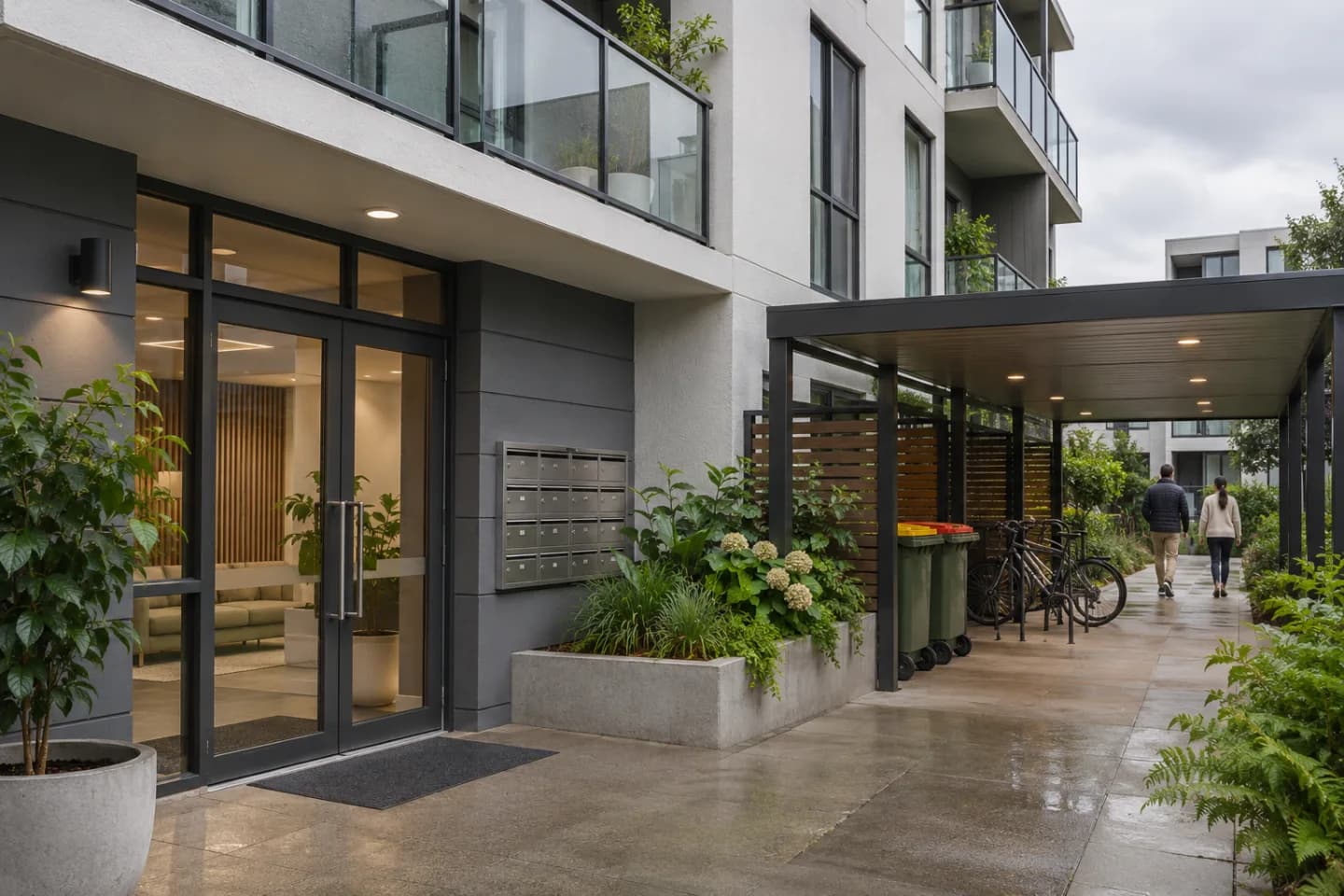
Follow the route you would take from the street or car park to your front door. Look at the shared areas you will actually use, such as the lift, stairs and waste room. If a lift is out or a wall is visibly damaged, ask the manager whether the work appears in the plan, has already been quoted or is still being investigated.
Check whether a lower levy reflects a simpler building, different services or a funding decision. Ask what your payment covers inside the unit, what it covers for the shared property and what you will buy yourself. Ask who handles repairs around the boundary between private and common areas.
Before you sign, write down one current cost you can verify, one cost that could change and one question that would affect your offer. Give each question to the person who can answer it. The agent can identify the unit and supply documents, the manager can clarify the budget, and your adviser can interpret obligations under the agreement.
Return to the Auckland city guide
- Ask for the levy for the exact unit, the billing schedule and a list of inclusions.
- Ask for the long-term maintenance plan, latest accounts and meeting minutes.
- Check any proposed or approved special levy, the unit’s share and payment dates.
- Budget for rates and individually paid costs using current records.
Questions to take with you
- Record the body corporate levy and rates for the exact unit and the dates they apply.
- Confirm which services are included and which expenses you will pay separately.
- Read the maintenance plan, accounts and meeting minutes together.
- Confirm whether a special levy is proposed, approved or payable and who is responsible.
- Get your lawyer to review both disclosure statements and the sale agreement.
How this guide was prepared
oyopo combines original architectural analysis with published information from architects and project teams. Sources identify the basis for project facts. The review date records the latest content check; design intentions and proposed facilities are distinguished from completed work. These articles are not site inspections or independent performance assessments.
Sources and further reading
Unit Titles Services: owner responsibilitiesBody corporate levies and examples of shared costs.
New Zealand Legislation: Unit Titles Act 2010Section 121 covers contributions to body corporate funds and the interests used to allocate them.
Unit Titles Services: pre-contract disclosure statementWhat a seller must disclose before signing, with different requirements for existing and off-the-plans units.
Unit Titles Services: pre-settlement disclosure statementRequirements and checklists for pre-settlement disclosure.
Unit Titles Services: unit title maintenanceLong-term maintenance planning, responsibilities and funding.
Unit Titles Services: managing body corporate financesOperating, maintenance, contingency and improvement funds.
Ray White: 430 Queen Street, Auckland CentralSelling agent’s published estimates of the annual levy and council rates, with stated inclusions. Reviewed 21 November 2026.
Ray White: 5D/2 Eden Crescent, Auckland CentralSold listing with the selling agent’s published annual levy and rates estimates. Reviewed 21 November 2026.