Chiang Mai · Choosing a home
Living in Chiang Mai
Where should you live in Chiang Mai? Compare Nimman, Santitham and Hang Dong by your weekly journeys, then check air quality, building costs and ownership before buying.
Where to live in Chiang Mai
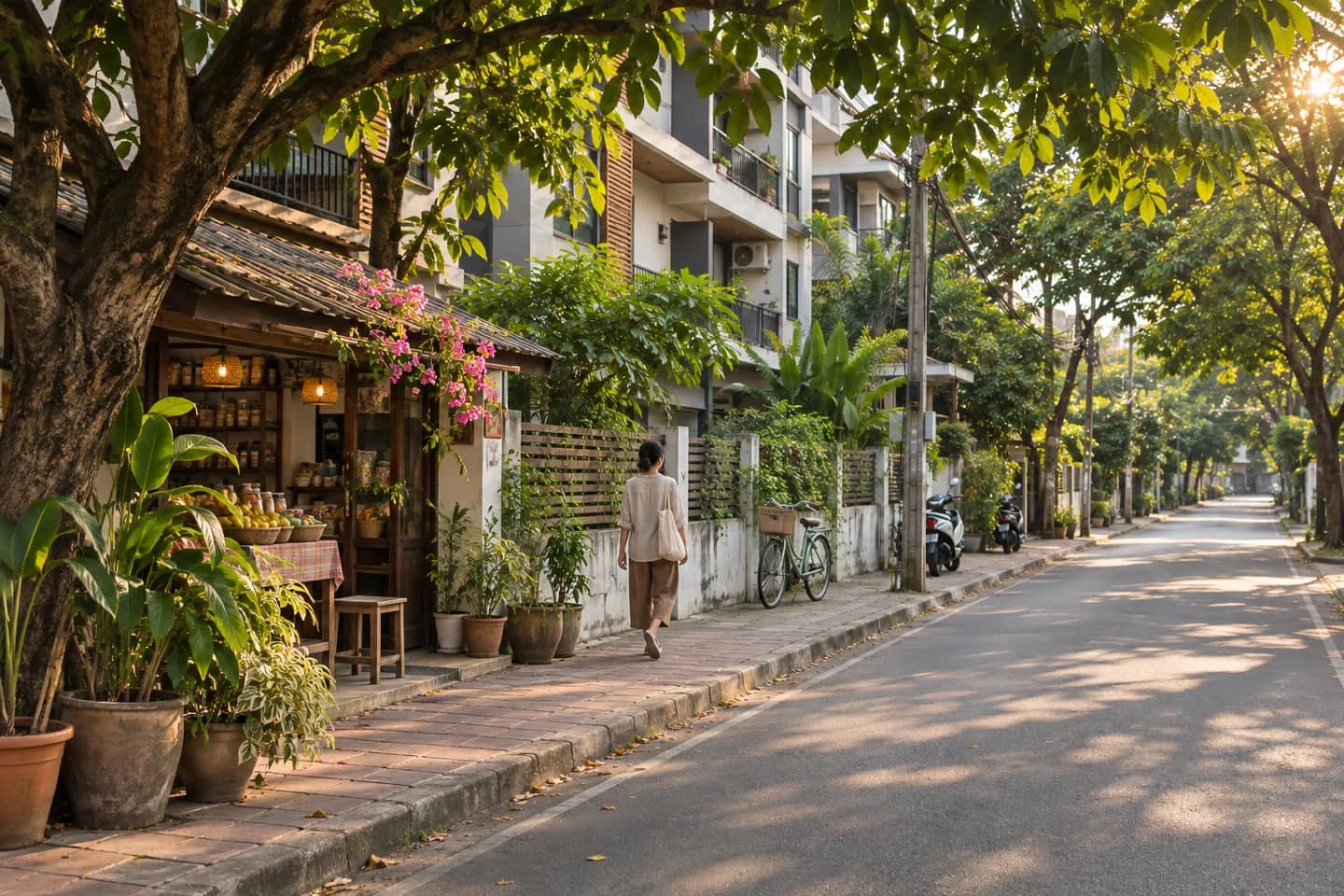
Start with three destinations you actually need each week. They might be work near the university, a school run and a supermarket. Compare exact addresses at the times you would travel. Include the walk from the unit to the street, the wait for a ride and the last crossing at the other end.
Nimman, Santitham and Hang Dong give you three different places to run that test. Use the comparison below to decide which addresses to visit first. The name in a listing gives you a starting point. The route from the front door is what you will repeat.
Explore homes and neighbourhoods in Chiang Mai
| Area | Start here if you want to test | Check on the ground |
|---|---|---|
| Nimman | A flat near cafés, services and your regular stops around Nimmanhaemin Road. | Crossings, the evening walk home, and noise inside the exact unit. |
| Santitham | A different city base around Santitham and Chang Phueak. | The grocery route, pavement gaps, lighting and ride pickup. |
| Hang Dong | A house or more outdoor space further from your city-centre destinations. | School or work journeys at busy times, access in rain and the cost of transport. |
Nimman, Santitham or Hang Dong?
Nimman. The Tourism Authority identifies Nimmanhaemin Road as an area for shops and food. Walk from the building entrance to a place you would use several times a week. Do it in both directions, including any large crossing. Inside the unit, stop talking for a minute with the windows closed, then open them briefly to hear how much road or venue noise reaches the room. Pay particular attention to the bedroom.
Santitham. Chiang Mai University Library’s aerial photograph places Santitham alongside Chang Phueak. For a present-day shortlist, compare the specific side streets. Walk a realistic errand after dark and note stretches with limited lighting, narrow shoulders or fast traffic. A door that looks close to a market on a map may still involve an awkward crossing.
Hang Dong. Use the exact address and district rather than a broad “Chiang Mai” tag. The Tourism Authority’s location record for the Night Safari is one geographic reference in Hang Dong. For a house search, try your regular trip into town at the hour you would actually leave. Include access to the property when it rains and check whether someone in the household could manage the same trip without the main car.
Take the same notes at each address. Write down the time from door to destination, any crossing or ride pickup you would dislike repeating, and the time it took to get back. Use these notes when deciding whether a larger floor plan or different setting is worth the trade-off.
Chiang Mai air quality and the burning season
Chiang Mai’s air quality can change significantly through the year. A study of official monitoring data for 2015–2024 found pronounced haze from February to April at Chiang Mai station 36T. A separate year-round study in Chiang Mai recorded its highest monthly average PM₂.₅ in March 2021. These observations help decide when to look at historical data. Conditions vary between years and locations.
Use Air4Thai to identify a monitoring station relevant to your shortlist and check the date and time of the reading. Look at daily PM₂.₅ concentrations if available, and compare them in the same units and over the same averaging period. An hourly reading and a 24-hour average answer different questions. AQI is an index, so keep it separate from PM₂.₅ measured in micrograms per cubic metre.
To plan around the Chiang Mai burning season, look across several dry seasons if you can find comparable records. Save the station name and periods you checked. A station reading describes the air near that monitor. It gives regional context for a shortlist, while conditions inside a specific home depend on the building and how it is used.
If you visit during a clear spell, ask how the home works when windows stay closed for longer. Check whether there are visible gaps around doors and windows, how kitchen and bathroom extraction work, and what kind of ventilation or filtration is actually installed. Ask for the make, model and maintenance schedule of equipment included in the sale.
Chiang Mai in the rainy season: check the address and the routes
The October 2024 ThaiWater report records the Ping River overflowing at Nawarat Bridge and flooding reported in several districts, including Mueang Chiang Mai, Hang Dong and Saraphi. That is a reason to ask about past incidents at a particular property and on its access roads. District names cover a wide area, so ask for evidence about the building and street you would actually use.
Start with the street entrance and the lowest parts of the property. Look at how the driveway slopes, where water drains and whether ground-floor doors sit above or below the street. For a condo, also ask about basement parking, the lift and electrical equipment. Ask the seller or manager what happened during previous heavy rain, which repairs were carried out and whether records are available.
Then try the access route. Find a second route to your regular destination and check where each crosses a river, canal or low road. Ask about access in heavy rain even if the unit is on an upper floor. A dry apartment can still be difficult to reach if the entrance or the only approach road is affected.
Buying a condo in Chiang Mai: inspect the exact unit
Ask for the unit number, level and plan before you visit. Compare the marketing area with the documents for the unit and note what is included in the measurement. Bring the dimensions of your bed, desk and sofa. Check door swings, circulation and whether you can reach storage when the room is furnished.
Walk the route from the entrance to the lift and along the corridor. In the unit, check the view out of the rooms you use most and look for potential obstructions or direct exposure to the afternoon sun. Check for signs of damp near windows, ceilings and wet rooms. Ask for documented repair history and arrange an independent inspection if something needs a closer look.
Where testing is permitted, try the taps, drainage, windows, locks, air conditioning and extractor. In a completed building, look at shared areas as well as the showpiece facilities. Mail delivery, visitor access, the lift and rubbish collection all become part of ordinary life. For a home still under construction, request the plan and inclusions for the exact unit and ask what notice you get if anything changes.
Buying a house in Chiang Mai: what to check in Hang Dong
A house viewing starts at the boundary. Walk from the public road to the gate and ask your adviser to check that the documents show a legal route to the property. Compare the plot and any shared driveway against the title plan. Ask who maintains the approach, and confirm which structures, parking spaces and outdoor areas the sale includes.
Inside and around the house, look at roof drainage, gutters, exterior walls, shaded areas and ventilation. Ask what equipment belongs to the property and request any records of roof or drainage work. Budget separately for garden care, pest inspections and work you would arrange yourself. If the house is in a managed estate, ask for the estate rules, fee schedule and responsibility for common roads and facilities.
When comparing a house with a condo, list who looks after the roof, exterior and shared areas, and what you would pay in a typical year. Confirm the legal ownership and access arrangements with your adviser. The viewing is a way to decide what needs independent inspection before you make a commitment.
Chiang Mai condo maintenance fees and the cost of living in the building
Ask the condominium juristic person, the body that manages the condominium, for the current common-area fee schedule for the exact unit. Check what is included, how often fees are billed, and whether the figure is based on floor area. Ask about the sinking fund, any amounts due from the seller and any separately billed parking, utilities or services.
For an illustrative 45 m² unit charged THB 45 per m² per month, the common-area charge would be THB 2,025 per month or THB 24,300 a year. These figures demonstrate the calculation. Use the building’s written schedule and the chargeable area for your own comparison. List one-off contributions and transfer costs separately.
Read the latest budget and meeting minutes if available. Look for repairs or replacements that could affect your costs or access, such as lift work or building waterproofing. Add your own transport, household utilities and likely maintenance inside the unit. A budget built around two exact addresses is more useful for choosing a home than a citywide cost-of-living average.
Can foreigners buy a condo in Chiang Mai?
Eligible foreign buyers can own a unit in a registered condominium under Thailand’s Condominium Act. The law generally limits combined foreign ownership to 49% of the total unit floor area in the condominium. The calculation is based on area. Ask the condominium juristic person whether sufficient quota is available for the exact unit and what confirmation can be issued for registration.
Ask an independent Thai property lawyer and the relevant Land Office to confirm what applies before you pay a reservation fee or deposit. Review the unit title, the seller’s authority and any registered encumbrances. Eligible buyers relying on an inbound currency route should ask the bank and lawyer which transfer evidence, payment description and names will be needed for their transaction before sending money.
If you are comparing a condo with a house in Hang Dong, ask separately what rights the contract gives you over the building and the underlying land. Thailand generally restricts foreign land ownership, subject to limited legal exceptions. Ask the lawyer to show what can be registered and in whose name, and to review refund conditions if the proposed transfer cannot take place.
From reservation to transfer: a Chiang Mai buying timeline
Before reserving, ask for the unit title or land documents, the seller’s details and a draft agreement. Get any promises about fixtures, repairs and access in writing. Have your lawyer check the payment schedule, who receives the deposit, and when it is refundable if an agreed condition cannot be met.
Before sending the balance, check that the transaction is ready to register. For a condo transfer involving a foreign buyer, confirm the required documents for registration, who will obtain them and how long they remain valid. Ask for an itemised statement showing the purchase price balance, applicable fees and taxes, and who is responsible for each amount.
On transfer day, ask your adviser what you should receive from the Land Office. Agree a separate handover list for keys, access cards, utility readings and the items included in the sale. Tell the building manager when access starts and confirm any move-in arrangements.
Questions to ask before buying property in Chiang Mai
Keep one comparison sheet for each address. Mark the things you verified yourself, the things you received in writing and the things nobody has answered yet. Give each unanswered question to the person who can resolve it. The selling agent can identify the unit and organise a visit. The juristic person can confirm building information. Your independent adviser can check the contract, ownership route and registration documents.
Include a move-in plan alongside the purchase price. Ask what happens between signing and transfer, who pays each cost, and when you can obtain keys and access. If unfamiliar with the city, consider living near your shortlist first so you can repeat the journeys and experience the home at different times of day.
Explore the Chiang Mai city page
- Ask the agent for the exact address, unit plan and a written list of fixtures included in the sale.
- Ask the building manager for current fees, planned work, building rules and available documentation for the transfer.
- Ask your adviser who owns the unit, what can be transferred and what happens to your deposit if a condition fails.
- Ask your bank what payment evidence it can provide before moving funds.
Questions to take with you
- Try two weekly journeys from the exact address at the times you would travel.
- Ask about past flooding, drainage and access after heavy rain at the exact address.
- Check historical PM₂.₅ from a relevant monitoring station and inspect how the home functions with windows closed.
- Match the seller’s plan, measurements and inclusions to the exact unit.
- Compare common charges, one-off contributions and transport costs in THB.
- Confirm the ownership route, title, quota if applicable and transfer requirements with an independent adviser before paying.
How this guide was prepared
oyopo combines original architectural analysis with published information from architects and project teams. Sources identify the basis for project facts. The review date records the latest content check; design intentions and proposed facilities are distinguished from completed work. These articles are not site inspections or independent performance assessments.
Sources and further reading
Tourism Authority of Thailand: Chiang MaiGeographic and local context for Nimmanhaemin Road.
Chiang Mai University Library: Chang Phueak and SantithamHistorical aerial photograph and place identification for the Santitham and Chang Phueak area.
Tourism Authority of Thailand: Chiang Mai Night SafariOfficial location reference for Hang Dong.
Air4Thai: Pollution Control Department monitoringOfficial monitoring portal. Check the station, timestamp, pollutant and averaging period.
Thai Environmental Engineering Journal: PM₂.₅ in Chiang Mai and Bangkok, 2015–2024Ten years of daily readings from station 36T in Chiang Mai and station 59T in Bangkok.
Chiang Mai University: year-round PM₂.₅ measurements in 2021Original Chiang Mai field study. Figure 2 shows monthly averages across 2021.
Thailand Department of Lands: Condominium ActThai statutory text published by the Department of Lands. See sections 19, 19 bis and 19 ter.
Thailand Government: Documents required for registrationRegistration documents, including condominium title and confirmation of foreign ownership proportion where applicable.
Thailand Government: Acquisition of real estate by foreignersSeparate requirements for condominium ownership and restrictions on land ownership.
ThaiWater: October 2024 water situation reportDocuments the Ping River overflow at Nawarat Bridge and affected districts. It describes a past event at district and wider scales.